Products · ARTEX

An autonomous pentester, inside your own walls.

ARTEX is an autonomous, LLM-driven penetration-testing platform. A planner decides what to look at next; several workers run real tools against the target; everything they find flows back into one shared picture of the system. A human watches, chats, and steers at any point. One binary, on your own infrastructure.

Autonomous planner → worker loop
In-house one binary on your infra
Authorized in writing, per target
artex · task-04
RUNNING
planner woke · frontier +3 intents
worker-1 claim · map subdomain → service
worker-2 claim · probe endpoint auth
proxy recording · egress authorized
guard 1 tool call pending approval
goals 2 / 5 proven · evidence stored
Dual graph What the target is, and how far we've probed it — kept apart, linked.
What ARTEX is

Not a scanner with a checklist. It is a small team that reasons, packaged as one binary.

ARTEX runs a penetration test the way a small team would. A planner reads the situation and emits concrete directions. Several workers each claim one direction, run real tools through a Kali-style shell and HTTP, and write back what they find. An event-driven engine closes the loop: every change to the graph wakes the planner, which emits new directions, until the goals are proven.

Autonomous, not a fixed script

The planner decides what to investigate from what is already known. It does not walk a list: it opens new directions only when something is uncovered, and stops when nothing is.

A dual-graph model

It separates what the target is (domains, services, endpoints) from how far we have probed it (goals, facts, findings). The two graphs cross-reference through anchors, and real coverage falls out of that.

Human in the loop

An operator watches the work live, chats with the system, and steers it: add hints, set goals, mark what is out of scope. You do not wait for a report to intervene.

Findings with evidence

A finding is a confirmed, reproducible vulnerability with its traffic stored. A reporter agent turns it into a write-up the board and the technical team can both read without a translator.

It runs inside

A single Go binary with the frontend embedded, backed by PostgreSQL. It deploys on your own infrastructure: the target's traffic and the evidence do not leave for a third-party SaaS.

Cost under control

Each task carries a cumulative LLM token budget. Spend is measured and capped per task, so a reasoning loop never becomes a surprise invoice.

Two graphs, one picture

The heart of ARTEX: what the target is, and how it was reasoned about.

The exploration graph is the lineage of the reasoning. A goal spawns intents; each intent, run by a worker, yields facts and findings; a fact can derive a fresh intent. Not a checklist — the chain of decisions, with its evidence anchored to real assets.

Inside the console

Real screens from an engagement — against a lab target, with synthetic data.

dashboard
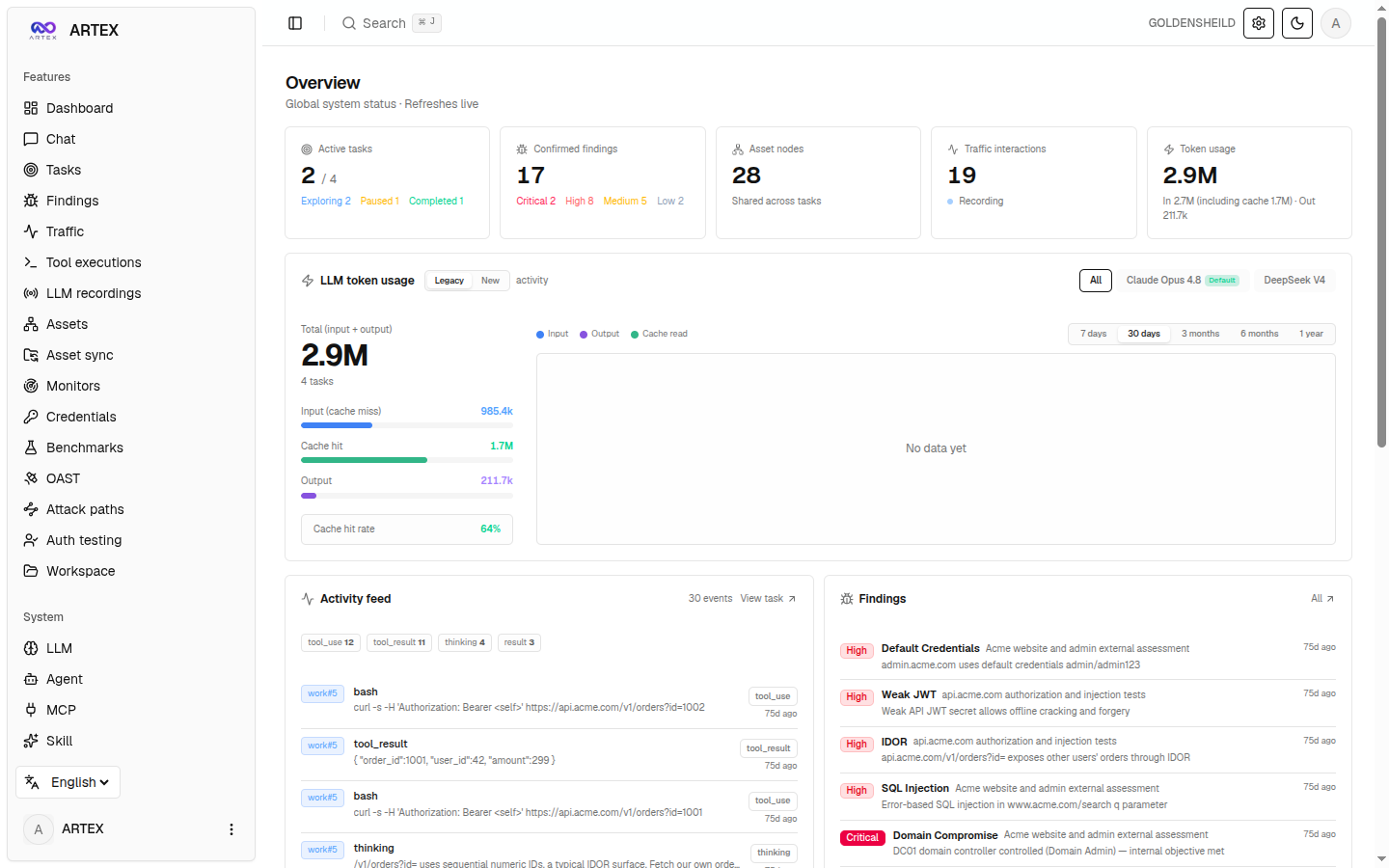
ARTEX dashboard: active tasks, confirmed findings by severity, asset nodes, traffic interactions and LLM token usage.
Live overview The whole system at a glance: active tasks, confirmed findings by severity, asset nodes, traffic interactions and token spend.
coverage
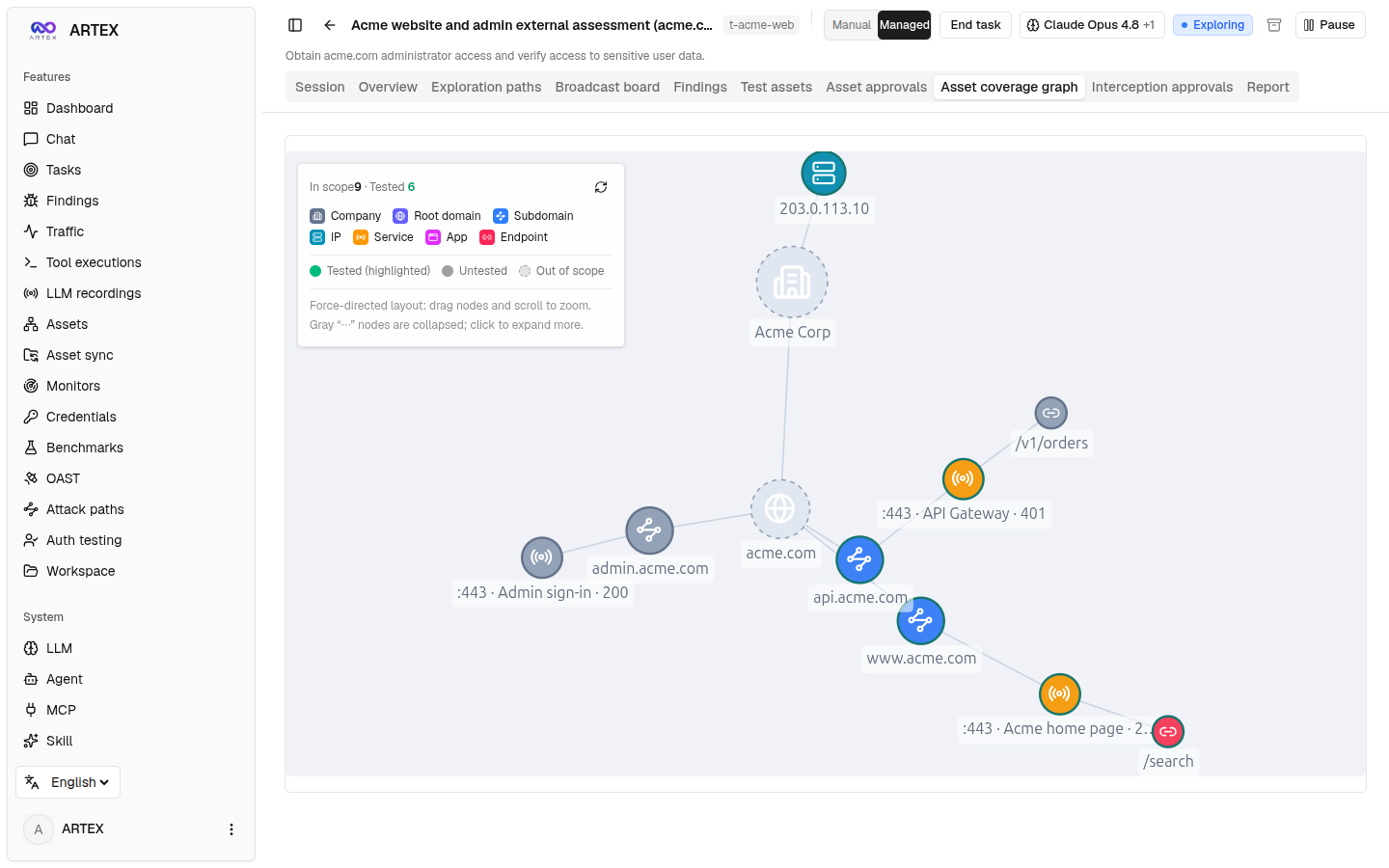
Force-directed asset coverage graph: company to domain to subdomains, services and endpoints, with tested nodes highlighted.
Asset coverage graph From company to endpoint, with already-tested nodes highlighted. It answers the one question that matters: what is left to look at.
control
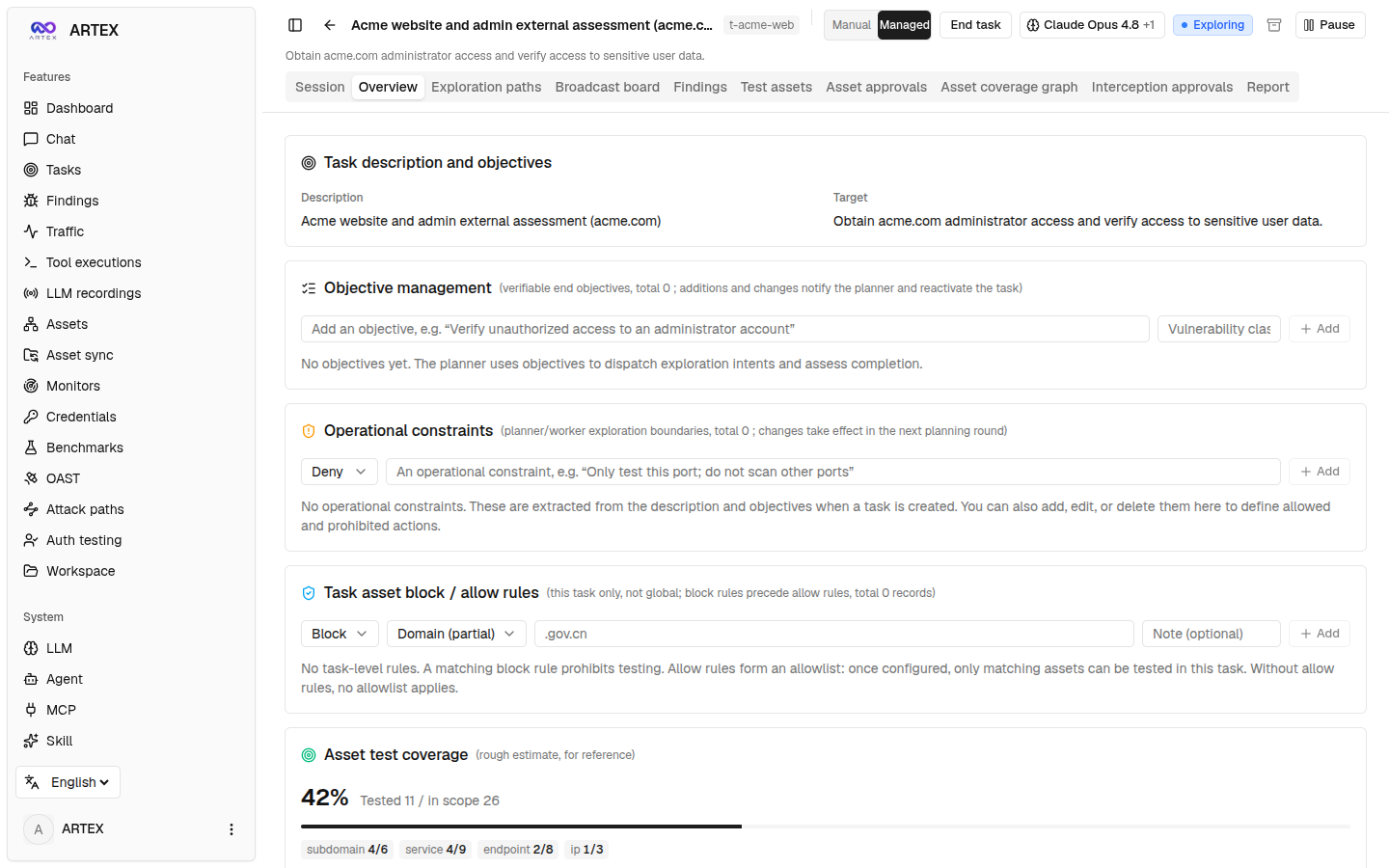
Task control surface: end objectives, operational constraints, per-task asset block and allow rules (.gov.cn blocked), and test coverage.
Scope, limits & budget Authorization made concrete: end objectives, operational constraints, per-task block/allow rules (here .gov.cn is blocked) and test coverage.

Real screens from the ARTEX interface, in English. Demonstration target (acme.com) and synthetic data.

Safety is the product

ARTEX drives real tools against real systems. Everything it does is fenced, recorded and approvable.

Scope that fails closed

Every task registers an authorized asset scope. Before a direction is claimed, authorization on those assets is re-checked; a block rule forces a close. Nothing gets touched by accident.

scopeenforced
scopein writing assetsallow / block claimre-checked on doubtclosed

Everything is recorded

A recording MITM proxy captures every request and response, and authorizes egress. No agent action without a trace: a finding's evidence is the traffic that produced it, not a screenshot.

proxyfull capture
capture = request + response
egress = authorized only
evidence = replayable

An approval gate

Sensitive actions pass through a gate: the operator can require manual approval before a tool runs. The system is autonomous by default and haltable in an instant.

guardintercept
  • pausecancels in-flight
  • approvalper tool
  • tenantisolated
auto approve

Who can use ARTEX

A tool that really attacks only goes to those who are really accountable.

ARTEX drives real offensive tools against real systems. That is why we do not sell it to anyone. We license it exclusively to publicly accountable organizations — listed companies and public-sector bodies — able to issue a formal, documented authorization for every system under test.

Publicly accountable organizations

Companies listed on a regulated market, and public-sector bodies. These are entities with governance, disclosure duties and a formal process to authorize a test — not an anonymous email address.

Written authorization, per target

Every engagement starts from a signed, authorized scope: which systems, for how long, under which limits. That scope is what ARTEX enforces in code, not a line in a contract.

Only systems you own or are permitted to test

Pointing ARTEX at something you neither own nor are permitted to test is not a supported use — it is an abuse of the product. The asset scope and the approval gate exist to make that line technical, not only moral.

We deploy and operate it with you

We do not hand over a binary and leave. ARTEX lands with deployment on your infrastructure, integration with your identity and telemetry, a runbook, and the same operating contract as everything else we do.

If you are not sure your organization fits these criteria, the answer is probably not yet — and we are happy to say so plainly. Access is deliberately narrow.

What's inside

The same things we already run in production — not a wish list.

Core
Single Go binary · embedded Next.js frontend · PostgreSQL
Agents
goals · planner · workers (N) · human-in-the-loop · reporter
Engine
event-driven loop · intent frontier · pause / timeout / drain
Deep tests
differential authz (BOLA/IDOR, privilege escalation) · out-of-band OAST · attack-path chaining
Safety
asset scope · recording proxy · approval gate · per-tenant isolation
Evidence
full traffic capture · reproducible findings · report
Cost
per-task token budget · spend measured and capped
Deploy
Docker · Linux x86-64 / arm64 · on your infrastructure
Languages
UI and agents in EN / ES (among others)
1 binary to deploy, no external registry dependencies
0 of the target's traffic leaves for a third-party SaaS
in writing a signed authorization before every engagement

Does your organization fit?

If you are a listed company or a public-sector body and want to test your own attack surface continuously, send us two lines about your organization and the scope you have in mind. Within 24h you get the next steps and the authorization requirements.

hola@pikas.systems
Listed & public sector only
Written authorization, per target
Español · English